
From Industrial Waste to High-Value Peptides: An Underestimated Opportunity in the Circular Economy
Overview
As the peptide market grows at an unprecedented rate, research (Colón-Sandoval et al., National Institutes of Health) highlights untapped opportunities in the modern circular economy.
The global food industry generates large amounts of industrial waste every year. Scientists are now extracting valuable sequences directly from this waste.
This article explains the pathways for extracting peptides from industrial byproducts, their application directions, and the real challenges this field faces.
1. Industrial Waste: An Overlooked Source of Peptides
The global food industry generates large amounts of industrial waste every year. In the past, most of this waste was treated as garbage or used for low-value purposes.
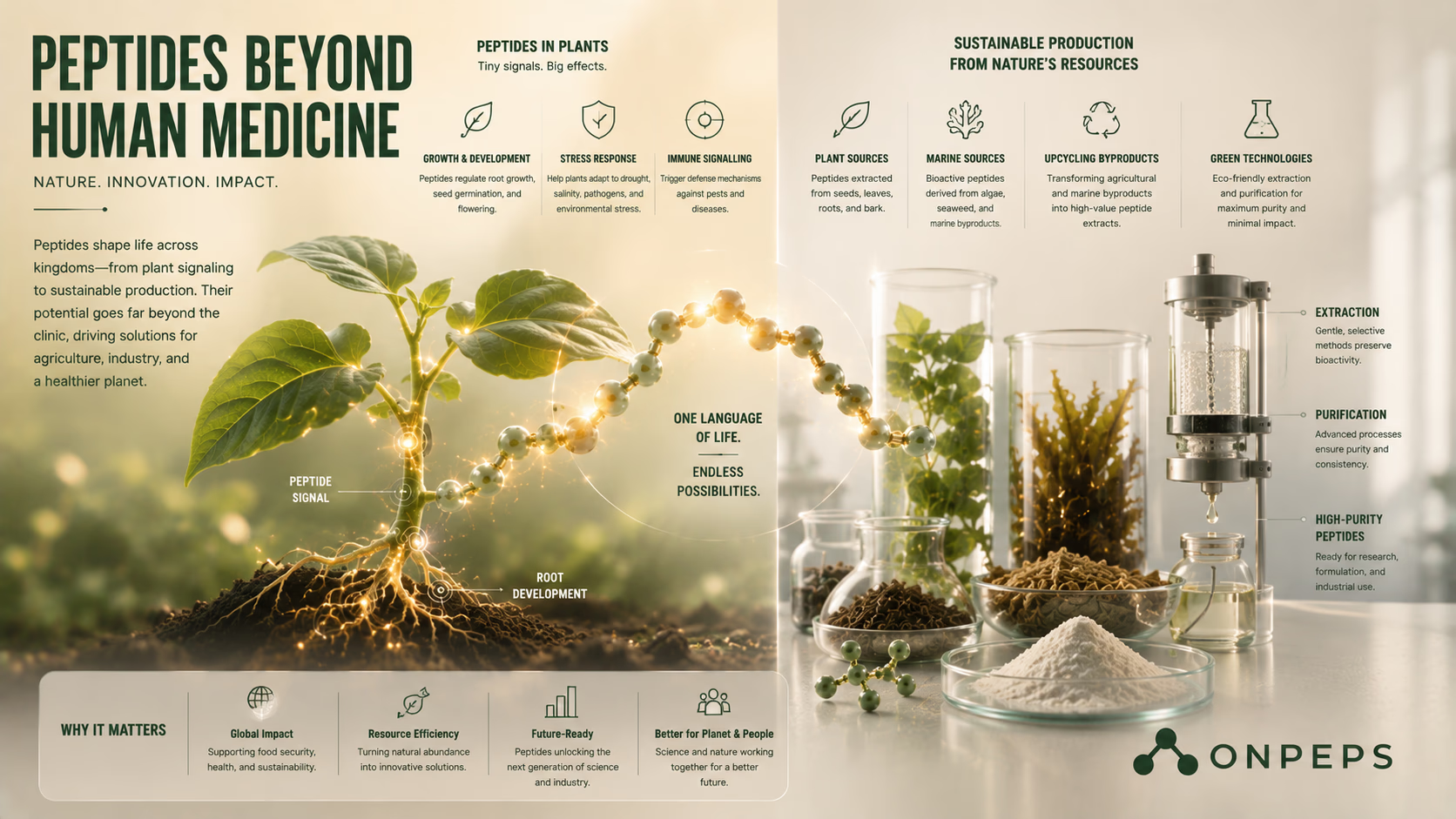
But scientists have found that this waste still contains large amounts of valuable peptide sequences. They use animal, plant, and marine byproducts to extract bioactive peptides.
This extraction process can convert discarded industrial waste into high-value nutraceuticals. It not only reduces waste but also provides new raw material sources for the food and pharmaceutical industries.
2. Plant Byproducts: Cardiovascular and Metabolic Functional Foods
Plant byproduct derivatives are a high-quality source of cardiovascular and metabolic functional foods.
Pumpkin seed oil cake and black sesame cake are rich in specific compounds that have natural blood pressure-lowering effects and can effectively inhibit angiotensin-converting enzyme activity in the human body.
Angiotensin-converting enzyme is a key enzyme in blood pressure regulation. Inhibiting its activity helps lower blood pressure and reduce cardiovascular burden.
This means that plant byproducts once treated as waste can, after extraction, become functional food ingredients with clear health benefits.
3. Marine Byproducts: Antimicrobial and Anti-Inflammatory Potential
Marine byproducts can produce unique molecules with powerful antimicrobial properties and significant anti-inflammatory effects.
These marine extracts show great potential for developing new drugs, offering a sustainable approach to controlling chronic inflammation and combating emerging pathogens.
Compared with plant byproducts, marine byproduct peptides tend to be more structurally diverse because they come from organisms adapted to marine environments. These molecules show unique advantages in antimicrobial and anti-inflammatory activity.
4. Real Challenges: From Laboratory to Commercial Product
However, the industry still faces many challenges today. Translating laboratory results into commercial products is very difficult and costly.
Manufacturers must address consumer choices regarding delivery systems.
Companies do need reliable methods to ensure that every batch of product is consistent. The methods used to break down proteins with enzymes must be identical across all factories. Cleaning and filtration steps must also strictly follow international standards.
These requirements mean that extracting peptides from waste is not simply a matter of processing waste, but a production process that requires strict control.
5. Cost and Technology: The Key to Success
Future research needs to focus closely on both technology and cost.
This approach only works when the cost of converting residual protein waste into valuable products is lower than using synthetic chemicals.
In other words, whether waste-derived peptides can be scaled up depends not on whether the technology is feasible, but on whether it is economically worthwhile.
This is also why the field is still in a development stage. The technology exists, but the cost still needs further optimization.
6. Summary
Extracting peptides from industrial waste is an underestimated opportunity in the circular economy. Its main characteristics include:
First, wide sources. Plant, animal, and marine byproducts can all serve as raw materials.
Second, clear applications. Plant byproducts can be used for cardiovascular and metabolic functional foods, while marine byproducts can be used for antimicrobial and anti-inflammatory drug development.
Third, real challenges. The cost of translating from laboratory to commercial product is high, and consistency requirements are strict.
Fourth, success depends on cost. Only when conversion costs are lower than synthetic chemicals can this direction truly scale.
Understanding this field helps explain how the peptide industry can move from traditional extraction toward sustainable utilization, and provides new ideas for the food and pharmaceutical industries.
Frequently Asked Questions
Which industrial wastes can be used to extract peptides?
Plant byproducts (such as pumpkin seed oil cake and black sesame cake), animal byproducts, and marine byproducts can all be used to extract peptides.
What are the uses of peptides extracted from waste?
Plant-derived peptides can be used in cardiovascular and metabolic functional foods, while marine-derived peptides can be used in antimicrobial and anti-inflammatory drug development.
Why is extracting peptides from waste costly?
Because it requires strict enzymatic methods, cleaning and filtration steps, and consistent product quality across batches — all of which increase costs.
What is the key to the future of this field?
The key lies in reducing costs. Only when conversion costs are lower than using synthetic chemicals will waste-derived peptides become commercially viable.